
Deutsch unten
SCHEIPUR
multi-channel video installation, performance
in collaboration with Nawroz Mahmud Qadir
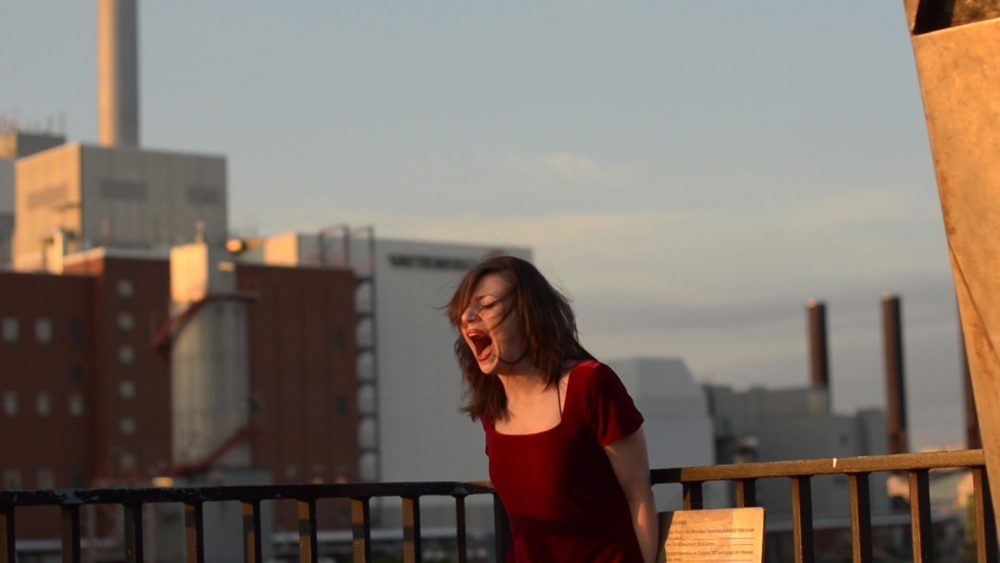
Scheipur (Persian/Kurdish: a hornist heralding the beginning of a war) explores the silence of the memorial culture as a part of the public representation of history.
It gives this culture a temporary feminine voice and a (self-parodying) feminine image to question the role of feminine figures and national identities in the memorial culture. Through different video images it connects Russian, German, Jewish and further memorial sites with ambivalent meanings and connections to our respective backgrounds.
The theme of the project is the conventions and ambivalences in the representation of the memorial culture in relation to the representation of gender. Can mourning of one person be at the same time a theatrical experience and the one that opens up borders, in which private and public, national, cultural, European and non-European belonging and identities become blurred?
Featured sites: deportation monument Putlitzbrücke, garrison cemetery Lilienthalstraße, Soviet monument in Treptow park, former concentration camp Columbia-Haus (Tempelhof field), Soviet monument in Schönholzer Heide.
SCHEIPUR
Mehrkanal-Video-Installation, Performance
In Zusammenarbeit mit Nawroz Mahmud Qadir
Scheipur (Persisch/Kurdisch: ein Hornist, der den Beginn eines Krieges ankündigt) untersucht das Schweigen der Erinnerungskultur als Teil der öffentlichen Darstellung von Geschichte.
Das Projekt verleiht dieser Kultur vorübergehend eine weiblich inszenierte Stimme und ein (selbstironisches) weibliches Bild, um die Rolle von femininen Figuren und nationalen Identitäten in der Erinnerungskultur zu hinterfragen. Durch unterschiedliche Videoarbeiten verbindet es russische, deutsche, jüdische und weitere Erinnerungsorte mit ambivalenten Bedeutungen und Bezug zu den jeweiligen Hintergründen von mir und Nawroz.
Wir untersuchen Konventionen und Ambivalenzen in der Darstellung von Erinnerungskultur im Verhältnis zur Darstellung von Gender. Kann die Trauer um eine Person zugleich eine theatralische Erfahrung sein – und eine, die Grenzen öffnet, in denen private und öffentliche, nationale, kulturelle, europäische und nichteuropäische Zugehörigkeiten verschwimmen?
Orte: Deportationsdenkmal Putlitzbrücke, Garnisonsfriedhof Lilienthalstraße, Sowjetisches Ehrenmal im Treptower Park, ehemaliges KZ Columbia-Haus (Tempelhofer Feld), Sowjetisches Ehrenmal Schönholzer Heide